My Role
Teams
Design, UX writing, research
Timeline
1.5 months
Focus
UX Strategy
PPL Electric's customer support team ran almost entirely through phone calls. As inquiry volume grew, the cracks in that single-channel model became harder to ignore. Customers were sitting in queues, dreading the call, and rushing through conversations because they knew that if anything went wrong they'd have to start the whole process over again.
The result was a feedback loop nobody wanted. Longer wait times, lower satisfaction scores, and higher operational costs all stemming from a channel that couldn't scale without adding more agents.
The channel problem
One single support channel handling all inquiry volume with no asynchronous fallback. Every spike in outages or billing issues translated directly into longer queues and more frustrated customers.
The blank slate
This wasn't a redesign with an existing brief. It was a whiteboarding problem to figure out what alternative channels could work, build the vision, and convince stakeholders it was worth funding.
Experience goal
Customers resolve issues on their own terms without waiting in a queue, repeating themselves, or needing to make a call at all.
Business goal
Secure stakeholder buy-in and funding to pursue 2-way SMS by presenting a credible, research-backed prototype that shows the channel's impact on CSAT and operational costs.
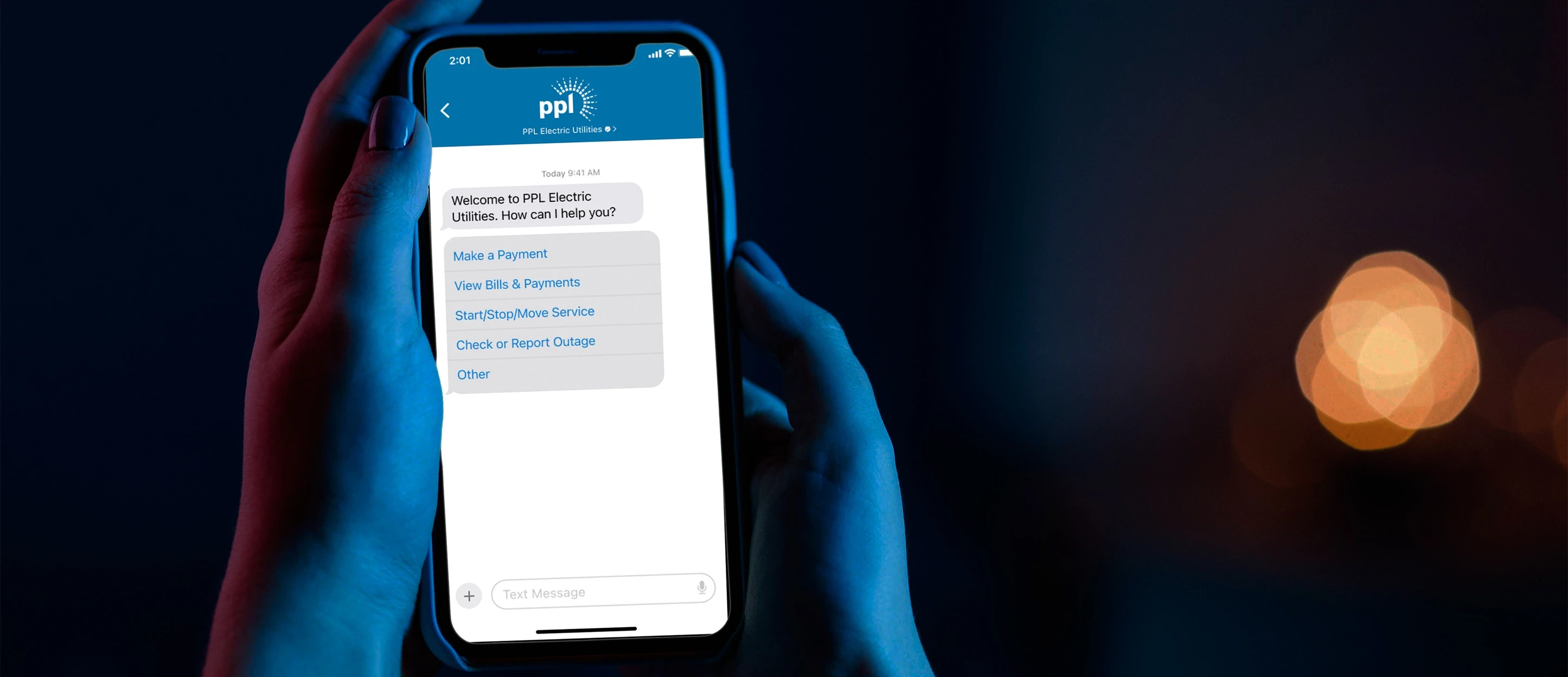
The first decision was which channel to pitch. We brainstormed across the landscape of alternative communication options such as chat, SMS, push notifications, and self-service portals. We landed on 2-way SMS as the highest-impact, lowest-friction option for PPL's customer base.
From there, I conducted full desk research into Apple Messages for Business. Looking into its capabilities, integration points, and how other companies had used it allowed me to understand exactly what we could credibly promise in a pitch and what would need further exploration.

Building the story to tell
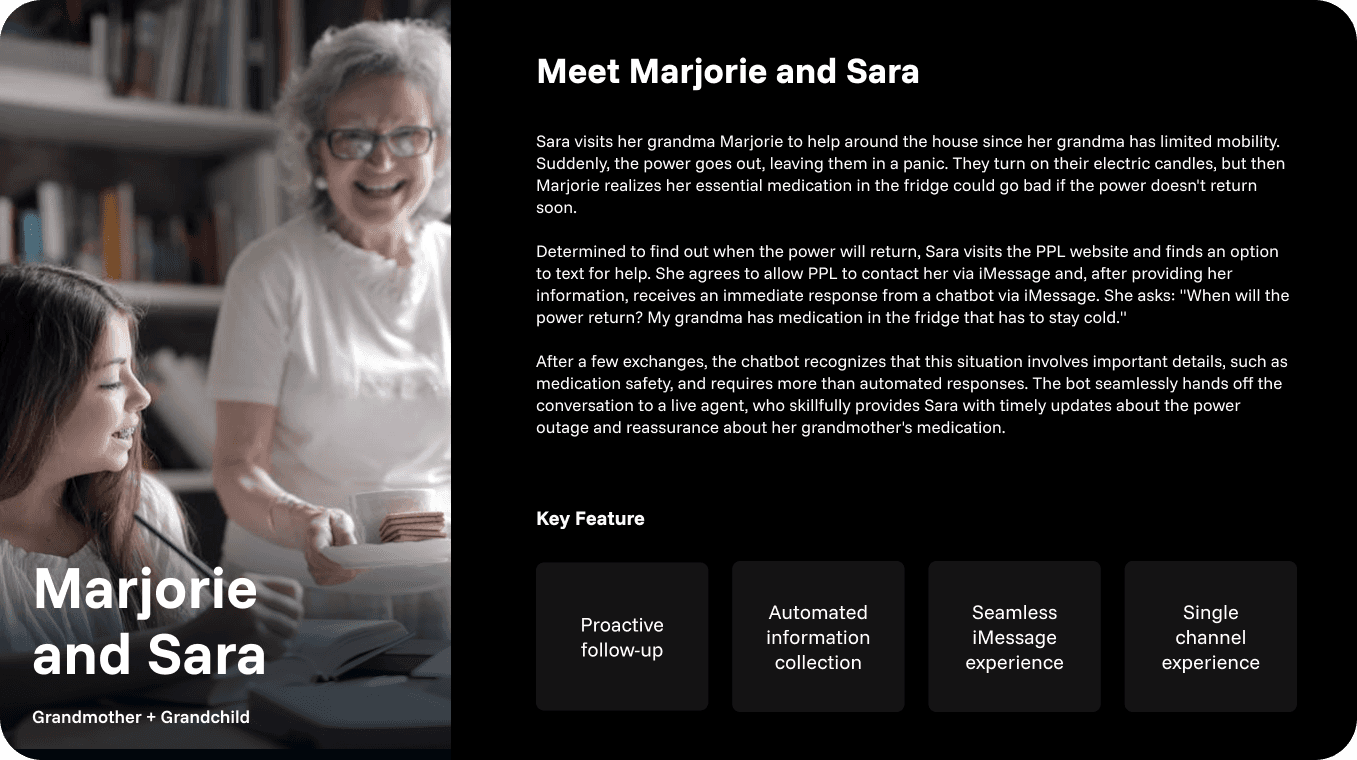
We wanted to showcase how 2-way SMS can make a simple service experience easier for both the customer and the agent. To tell this story I created two users Marjorie and Sara.
In this scenario, Majorie and her granddaughter, Sara, experience a power outage randomly. Panic arises when Marjorie realizes her essential medication needs to stay refrigerated. To help, Sara visits PPL Electric's site and sees an option to text for help.
Story first, screens second
Before building any UI, we wrote the conversation. Working closely with a UX writer, we mapped every message, response option, and escalation point in the Marjorie and Sara scenario. Tone, language, and voice had to be consistent not just with each other but with PPL Electric's broader brand.

The three-phase story


Phase 3:
Payment Integration
Showcasing how a simple service transaction is done, we also iterated on ways it can impact the customer experience and give one extra step in delivering a delightful experience.
We explored how integrating IOS can provide customers with features like, Apple Pay billing, seamless appointment scheduling, and secure file transfer.

Lead with a human story, not a feature list
Stakeholders evaluating a new channel investment don't connect with capability matrices, they want to learn about the scenarios where having an additional channel will support the customer.
Write the conversation before designing the screens
Collaborating with a UX writer from the very start, not handing off finished screens for language review, produced a prototype where the words and the visual design felt like one thing, not two.
Make the pitch a prototype, not a deck
Building a prototype lets stakeholders feel what the experience is like. The prototype was the argument made tangible.
Connect features to CSAT, not
just capability
Every feature demonstrated; bot intake, smart escalation, Apple Pay, scheduling, was framed in terms of what it meant for customer satisfaction scores and call deflection rates.