My Role
Teams
Design, Product, Dev, Business
Timeline
2 months
Focus
AI roadmap, search UX, LLM design
PPL Electric's internal search tool returned results but not answers. An employee searching "holiday" got a list of documents instead of the specific thing they needed — their PTO balance, the schedule, the policy. With LLM-powered products reshaping what search could feel like in the consumer world, leadership wanted to know what it would take to bring that same effectiveness in-house.
The ask wasn't just to redesign the search tool. It was to design the roadmap — to show, concretely and visually, how search could evolve from what it was into something that felt like asking a knowledgeable colleague, not querying a database.
User problem
Search returned results but didn't understand intent. An employee searching "holiday" got a list of documents rather than the specific answer they needed about PTO, schedules, or company policy.
The opportunity
LLMs had made conversational, intent-aware search technically feasible. The design challenge was to map a credible path from where the system was to where it could be. We needed to make that path feel achievable, not theoretical.
~22 %
Increase in search relevance rates since federated search deployment
Measured post-launch
3 stages
Visual system covering federated, unified, and AI-powered search
Crawl, walk, run framework
Centralised metadata system enabling scalable AI integration
Foundation for future LLM
Experience goal
Make search feel like asking a knowledgeable colleague, not querying a database. Surfacing the right answer, not a list of documents to sift through.
Business goal
Prove a credible, incremental path from federated to conversational search that leadership could fund stage-by-stage, grounded in metadata foundations that scale into AI.
The real challenge wasn't visual. It was credibility. A single "future state" mockup would have been easy for stakeholders to dismiss as a moonshot — impressive in a deck, unbuildable in practice. I needed to map a path that felt achievable at every step, for a group of design, engineering, and business stakeholders who'd never shared a workplan before.
To keep the work grounded, I anchored every decision to one persona: Alex, mid-search for "holiday." Abstract questions about personalization, metadata weighting, card types, all got tested against one question, would this actually help Alex find what they need?

Rather than presenting a single future-state vision, we mapped a phased evolution — each stage building on the last, each one shippable and independently valuable. This gave stakeholders a roadmap they could commit to incrementally, rather than a moonshot that required betting everything at once.
Federated search
Pulls results from multiple disconnected systems into a single interface. No personalisation yet — but it eliminates the need for employees to know which system to search in. A 22% improvement in search relevance came from this stage alone. The foundation for everything that follows.
Unified search
Results are consolidated, tagged, and weighted by relevance to the user's role and context. Modular cards surface the most useful result types — policies, calendar events, forms — without the employee having to filter. Metadata standardisation at this stage is what makes the AI layer possible later.
AI-powered smart search
Search understands intent, not just keywords. A query like "holiday" resolves to a personalised summary of upcoming dates, the employee's remaining PTO, and a one-click path to submit time off — without the employee having to ask multiple questions. The UI becomes a guide, not a results list.
Conversational GPT search
A fully conversational interface — the employee doesn't search, they ask. Real-time analytics, multimodal inputs, and generative AI combine to answer questions, surface proactive insights, and complete tasks on the employee's behalf. The search bar becomes a workplace assistant.

Modular UI Design Library
A core constraint from the brief was that all three search stages needed to share the same design language — same typography, colour treatment, text hierarchy, padding, and component architecture. This meant building a modular UI system first, then applying it across each evolutionary stage rather than designing each screen in isolation.
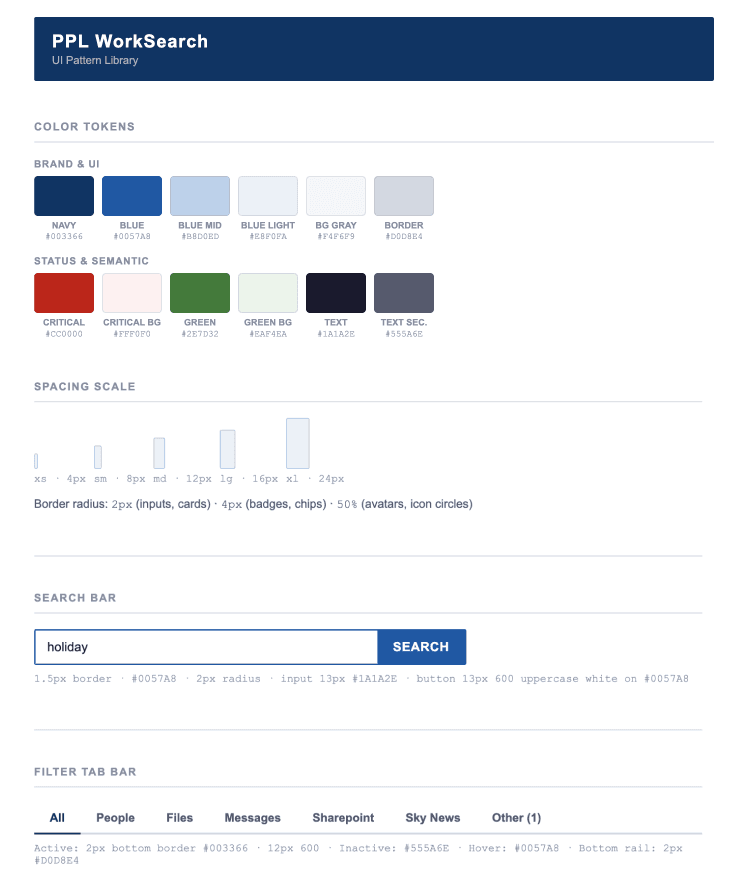
With multiple stakeholders weighing in on what personalisation should look like — how metadata would be weighted, what card types should appear, what tagging logic would drive relevance — alignment was a constant challenge. This was all account for in the Design System.
Tangible Roadmap
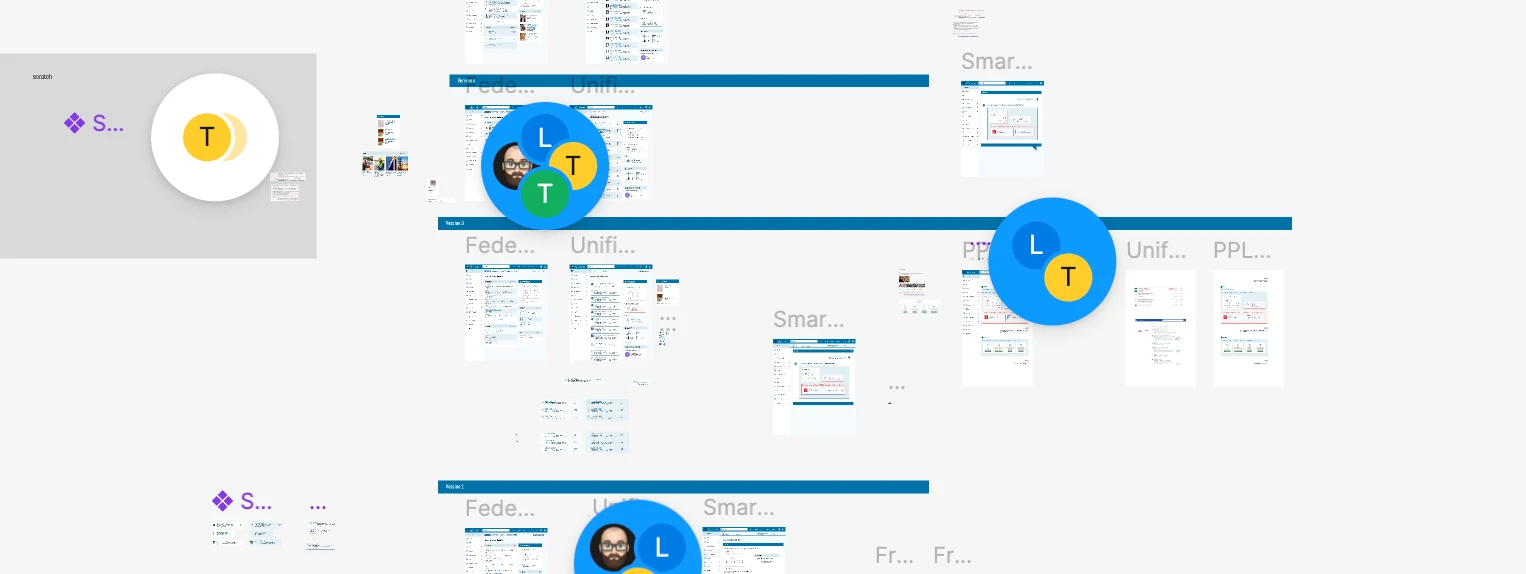
Stakeholder buy-in for an AI roadmap is hard to secure with words. By designing all three stages as high-fidelity screens with a shared design language, the progression from federated to conversational became something people could see and respond to — not just approve in the abstract.
Persona as a design constraint
Alex's holiday search wasn't just a demo scenario — it was a constraint that kept every design decision grounded. Every card type, every metadata tag, every personalisation decision was evaluated against: would this actually help Alex find what they need?
Launch
The crawl-walk-run-fly framework wasn't just a presentation device — it was a delivery strategy. Each stage is independently valuable and deployable, so the organisation can realise returns before the full AI vision is built.
Relationship building
The AI roadmap forced early, structured collaboration between design, engineering, and leadership — groups that hadn't shared a workplan before. Presenting each stage as an independently shippable milestone, rather than a single ask, built trust incrementally instead of requiring a leap of faith upfront.
Delivered production-ready designs for federated and unified search, along with documentation of the modular system and the design rationale for each stage. The AI-powered and conversational stages were delivered as a roadmap and vision prototype — giving stakeholders a concrete picture of where the investment was heading.


While we handed off the both federated search designs with unified search as a fast follow, the team wanted to give leadership a taste of what a personalized AI experience would look like for a scenario like an employee searching for "Holidays." We shipped this as a blue sky vision of what employee search can be someday.

1
Why the metadata work matters
LLMs are only as good as the data they're grounded in. By centralising and standardising PPL Electric's metadata framework now, the unified search stage creates the clean, consistent data layer that a retrieval-augmented generation (RAG) system needs to answer questions accurately rather than hallucinate.
2
Intent over keywords
The design principle established through Alex's persona, that a user's query and their actual need are different things, is exactly what LLMs are built to bridge. The conversational stage isn't a separate product; it's the natural continuation of the intent-first design thinking introduced in stage one.
3
Modular UI as an LLM shell
The modular card system wasn't just a visual constraint. It's the right UI architecture for an LLM-powered interface. When a model generates a response, it needs structured components to render answers in, not a blank text field. Each card type in the system maps to a category of answer the LLM can return.